
Use the app for Mac, iPhone and iPad
In the app · English
Tools → Slope finder
For describing a measured incline. Enter the vertical difference between ends and the horizontal projection, not the distance along the slope.
- Rise
- The vertical difference must be greater than zero.
- Run
- The positive horizontal distance corresponding to that rise.
The calculation starts with rise and run and returns percent and degrees. It does not solve backwards from a requested slope or accept a signed fall.
- Slope percentage and angle above horizontal.
A small rise over a measured horizontal metre.
| Quantity | Value |
|---|---|
| Rise; run | 150 mm; 1000 mm |
| Slope; angle | 15 %; 8.531° |
Slope = 150/1000 × 100. Angle = atan(150/1000). A 15% grade is therefore not a 15° angle.
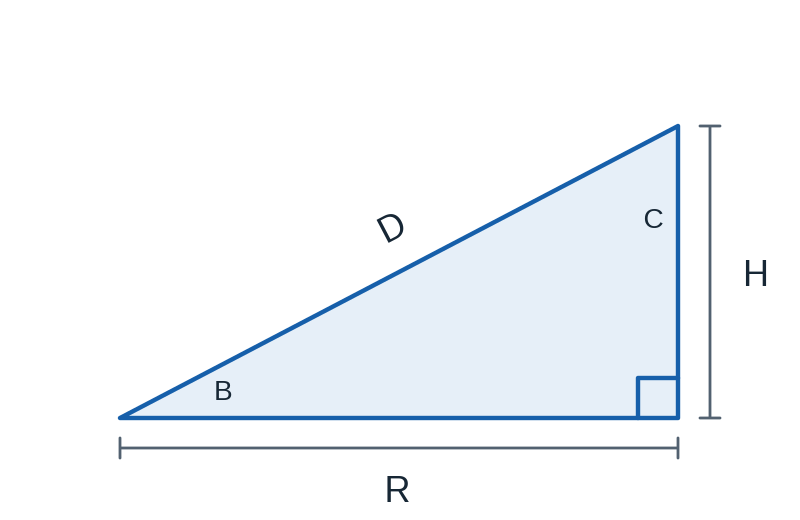
Percent compares vertical change with horizontal distance; degrees describe the angle above horizontal. Use the horizontal distance, not the inclined surface length.
In 1:n, one unit of vertical change corresponds to n units horizontally. Divide the horizontal distance by n to find the rise or fall in the same unit. Use this when setting out ramps, roof falls and drainage.
Scroll the table horizontally, or focus it and use the arrow keys.
| Slope (%) | Angle (°) | Vertical change (mm/m) | Vertical : horizontal (1:n) | Vertical change (in/ft) |
|---|---|---|---|---|
| 1% | 0.573° | 10 | 1:100 | 0.12 |
| 2% | 1.146° | 20 | 1:50 | 0.24 |
| 3% | 1.718° | 30 | ≈ 1:33.333 | 0.36 |
| 5% | 2.862° | 50 | 1:20 | 0.6 |
| 7.5% | 4.289° | 75 | ≈ 1:13.333 | 0.9 |
| 10% | 5.711° | 100 | 1:10 | 1.2 |
| 15% | 8.531° | 150 | ≈ 1:6.667 | 1.8 |
| 20% | 11.310° | 200 | 1:5 | 2.4 |
| 25% | 14.036° | 250 | 1:4 | 3 |
| 50% | 26.565° | 500 | 1:2 | 6 |
Angles and repeating ratios are rounded to 3 decimal places.
Example: a specified 2% fall over 5 m of horizontal distance needs 100 mm of fall: 5 × 2 ÷ 100 = 0.10 m. That is 20 mm per metre and an angle of approximately 1.146°, not 2°.
To check this geometry in Pro², enter positive rise magnitude 0.10 m and horizontal run 5 m. Record the downward direction separately on your plan. Measure from one stated datum; the example does not prescribe a drainage, pipe or accessibility gradient.
Use metric or imperial lengths consistently and keep extra precision until the final display. Rounded diagram labels are not a measuring tolerance.
The result describes geometry. It does not approve a ramp, roof or drainage gradient for a particular use. Use positive magnitudes and record the direction of fall separately.
Can I measure run along the inclined surface?
That is the hypotenuse, not the horizontal run. Use Right Triangle if you need to resolve those sides first.
What does 100% slope mean?
Rise equals horizontal run, so the angle is 45°, not vertical.
- Can I measure run along the inclined surface?
- That is the hypotenuse, not the horizontal run. Use Right Triangle if you need to resolve those sides first.
- What does 100% slope mean?
- Rise equals horizontal run, so the angle is 45°, not vertical.
Check your understanding of slope
Rise is 0.3 m and horizontal run is 4 m. What is the slope in percent? You do not need the sloping length for this question.
Show the answer and explanation
The slope is 7.5%. Divide rise 0.3 by horizontal run 4, then multiply by 100. Dividing by the sloping length would describe a different quantity.
Answer: 7.5% = 0.3 / 4 × 100.
Measurements, units and material terms
Back to the category